Ivanchuk Is Here
A surreal night of meeting a chess legend in Charlotte

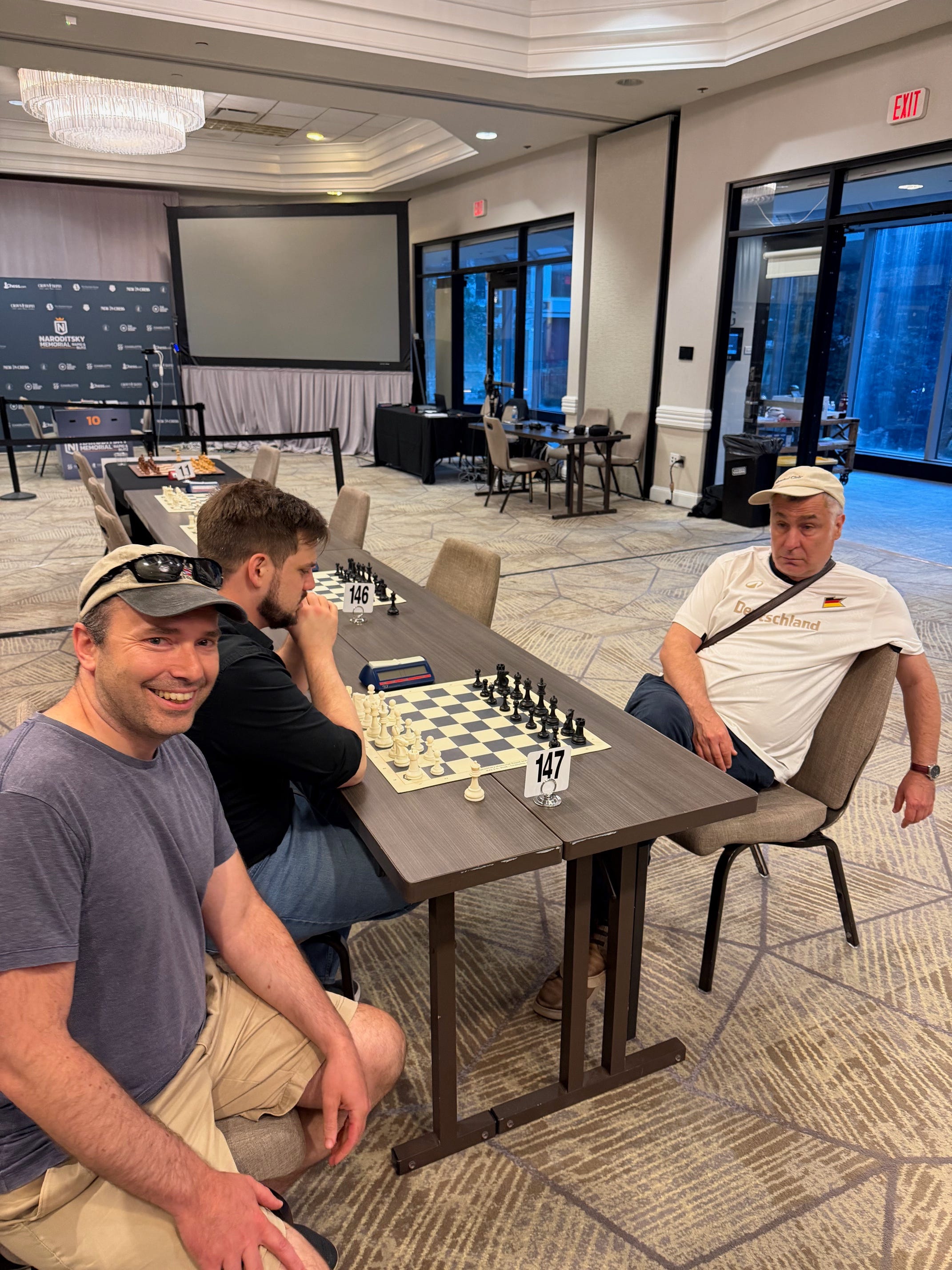
“Ivanchuk is here.”
These three words made me look at my phone in disbelief.
“I’m sorry Paul, I have to run to meet a legend,” I told my student as I wrapped up my lesson at the Marriott and literally ran towards Eddie V’s down the street.
Five minutes later, I walked into a busy, upscale bar in downtown Charlotte. I spotted my buddy Mike and GM Steven Zierk. They looked at me with a sparkle in their eyes and pointed to the person sitting next to them: Vasyl Ivanchuk.
Ivanchuk was wearing a baseball hat sideways. His eyes were tired, and he looked anguished, staring somewhat outwardly. He had just made a horrible blunder to lose in the last round vs… the very person sitting next to him.
Yes, that’s right. Steven had just beaten Ivanchuk in the 10+5 rapid at the Daniel Naroditsky Memorial.
Somehow, the Ukrainian legend had walked into this exact restaurant — one of about 50 places to eat downtown. Not only that, but he agreed to sit next to my friends and the man who had just defeated him. Is this destiny? was going through my mind.
Why would Ivanchuk dine at such an upscale spot? He was clearly not interested in the prime cuts of steak or the live jazz band nearby. He graciously agreed to drink one beer on Mike, but only one. He wasn’t interested in the smoked Old Fashioned that Mike and I had enjoyed earlier, nor the friendly banter with the bartenders who were trying to guess the spelling of Mike’s first name.
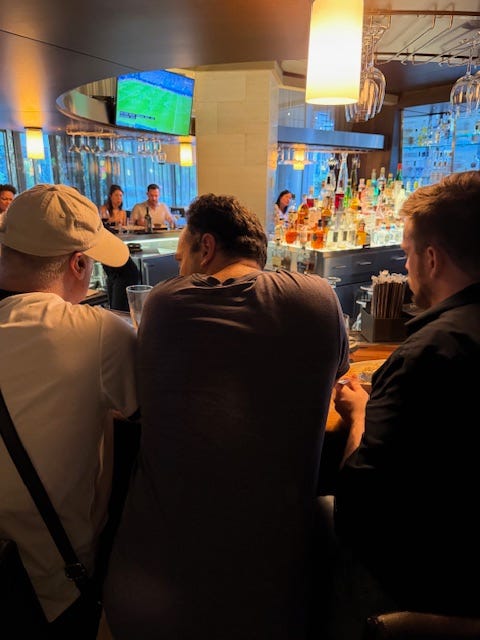
Ivanchuk finished his dinner of sea bass and ordered hot tea with lemon. Maddy, the bartender, asked if he would like honey and sugar. Chucky said yes to both, not hearing exactly what she said over the loud jazz band.
“Vasyl, do you remember me?” I asked. “My name is Zhenya (the Russian version of Eugene), and you gave a lecture to me in Lviv around 1991 at the Beliavsky and Mikhalchishin school of chess.”
No, he said, he didn’t recall.
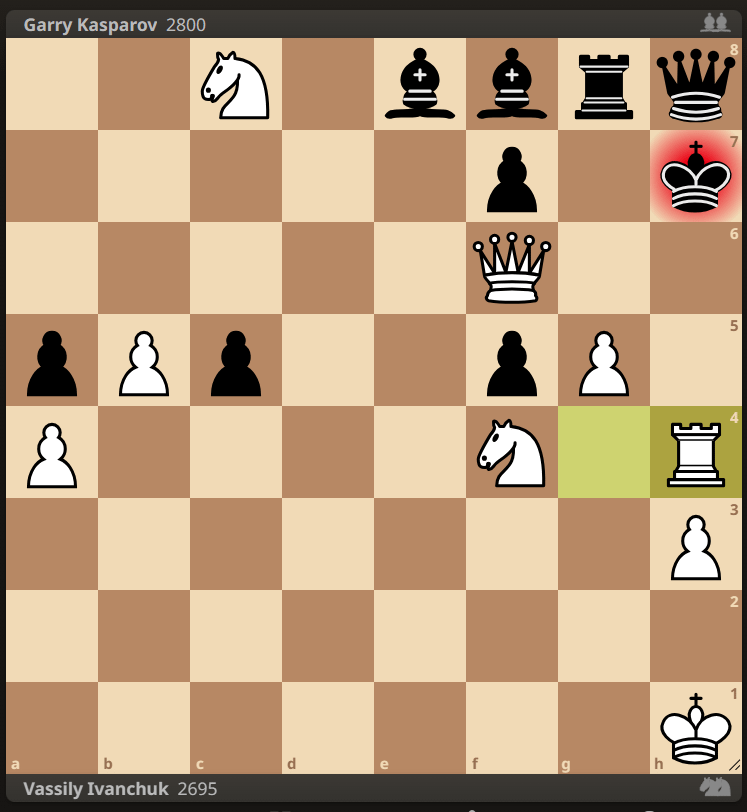
I reminded him that he gave the lecture in Ukrainian, a language only a few people spoke at that time. Most kids, including myself, only spoke Russian, as it was the dominant language in Ukraine during the time of the USSR. Yet, I vividly remember he called the pawn peshak — a slightly funny, localized version of the Russian peshka. During that lecture, Ivanchuk went over his famous victory over Kasparov from Linares. His analysis was completely over our heads, yet the energy and intensity kept us on the edge of our seats.
“No, I don’t remember you,” he said again.
I told him my life story about becoming one of the top juniors in Russia, moving to the United States, and meeting my coach, GM Roman Dzindzichashvili.
“Ah, Dzindzi,” his eyes lit up for a moment. “Do you live in Charlotte?” he asked.
“No, I live in Boston,” I replied. “I’m here to coach my friend Mike, who’s a Master.”
Ivanchuk looked at Mike at some point and asked in very clear English, “And what do you do for a living?”
“I’m a pharmacist,” Mike said.
Ivanchuk nodded and looked back at the TV screen above the bar. It was a soccer game between Messi’s Argentina and the unicorn team of the tournament, Cabo Verde. The score was tied, and Steven and I were chatting in disbelief about what would happen if the game went to penalties and Cabo Verde’s 40-year-old goalie made some more spectacular saves to upset Messi. Ivanchuk was wearing a German soccer shirt, but he told me he was barely following the World Cup. He said he liked Brazil, and the next day, he wore a Brazil shirt at the blitz tournament.
We asked Vasyl if he would be interested in looking at some chess back at the hotel.
“Do you have a set?” his eyes lit up.
We said yes and headed back to the Marriott. To our surprise, the playing hall was still open. There were about 200 chess sets set up, and not a single soul in the room.
We sat down at a board, and I asked Steven to show us one of his games, as he had a great Rapid event — beating Caruana and Ivanchuk, and drawing Wesley So and Bortnyk. We started looking at the Moscow Variation from his game vs. Wesley, and quickly got bogged down in the opening nuances.
Ivanchuk, visibly tired from a long day of chess and possibly still jetlagged, suddenly got animated and completely overwhelmed us with his chess ideas.
It was pure magic. It was something that I haven’t experienced since the engines took over. This is pure, old-school chess: the rapid flow of moves, hands flying across the board, ideas, thoughts, mistakes, takebacks, new ideas, deep tactics. The sheer volume of analysis overwhelmed me.
I looked around the empty room as two youngsters walked in, sat down at a table next to us, and started playing casual blitz. One of them casually suggested a brilliant ...Nb6 idea in some complex Dragon setup while playing his own game. Ivanchuk nodded and looked to his left.
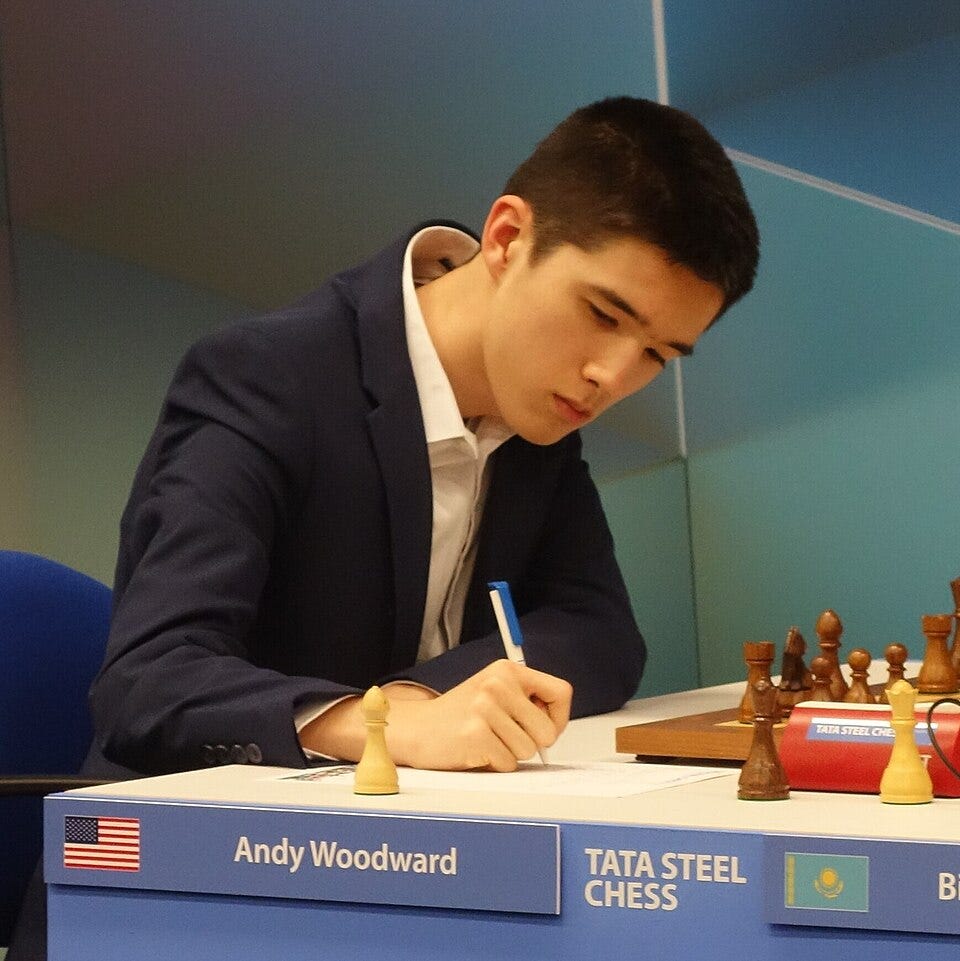
It was a scrawny 16-year-old Andy Woodward. The winner of the Tata Steel Challengers, and one of the top juniors in the world. Perhaps the next Bobby Fischer?
We continued analyzing for hours. Suddenly, a visibly tired Ivanchuk yawned and said he was done. We thanked him, and he left.
I sat there, awe-struck for a few moments, the image still burning in my mind.
Ivanchuk is here.